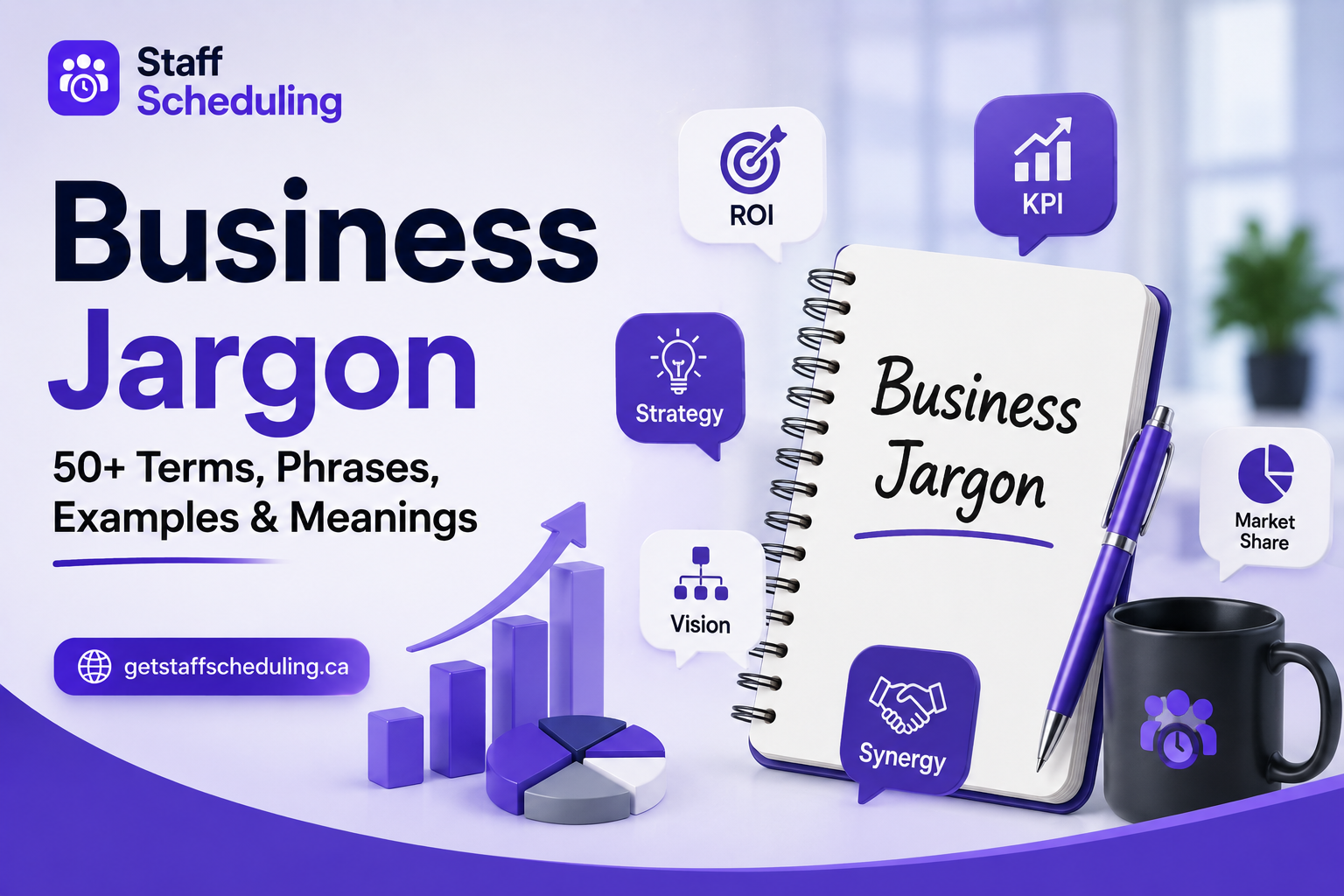
Business jargon is the special language people often use at work. It includes common terms and phrases used in meetings, emails, reports, and everyday workplace conversations. Words like “circle back,” “pivot,” and “move the needle” are common examples.
Professionals use this language because it can make some work conversations quicker and easier, especially when everyone on the team knows what the terms mean. It can also help people understand their role, work better with others, and take part in professional conversations.
But too much jargon can make a simple idea hard to understand. That is why knowing both the meaning of common business buzzwords and their simpler alternatives can be useful. In this guide, you’ll find common business jargon, corporate terms, professional language, and clear alternatives you can use at work.
What Is Business Jargon?
Business jargon means words and phrases that people commonly use in the workplace to talk about tasks, ideas, plans, and results. Some terms are used so often that they can feel like a separate language.
For example, a manager might say, “Let’s circle back tomorrow” instead of simply saying, “Let’s talk about this tomorrow.” Both mean almost the same thing.
Business jargon can be useful when a team already understands the terms. However, using too much of it can make simple messages confusing, especially for new employees, customers, or people who are not familiar with the field.
Business Jargon Meaning
In simple words, business jargon is workplace language used to describe common business ideas or actions.
These terms can refer to many parts of work, such as:
- Planning and strategy
- Teamwork and management
- Sales and marketing
- Meetings and communication
- Business growth and results
- Projects and daily tasks
For example, “deliverable” means something that needs to be completed and given to someone. “Bandwidth” can mean the time or ability a person has to take on more work.
Business Jargon vs. Business Lingo
Business jargon and business lingo are closely related, but they are not exactly the same.
Business jargon usually means special terms or phrases used in a business, industry, or profession. Business lingo is a broader term for the way people in a business or industry commonly speak.
For example, “ROI” is business jargon because it has a specific business meaning: return on investment. A phrase like “circle back” can also be part of everyday business lingo.
Both types of language can help people communicate quickly when everyone understands them. The problem starts when these terms are used without explaining them to people who may not know what they mean.
Why Is Business Jargon Used?
People use business jargon for several reasons. It can give teams a quick way to talk about ideas, tasks, and problems they deal with regularly.
For example, employees in the same company may use specific professional terminology because they already understand its meaning. This can save time during meetings and make team discussions easier.
However, jargon is not always the best choice. If a simple word can explain an idea more clearly, using that word is often better. Clear communication helps employees, customers, and business partners understand the message without having to guess what a term means.
Why Do Businesses Use Jargon?

Businesses use jargon because it can give employees a quick way to talk about common tasks, ideas, and problems. When everyone on a team understands the same terms, business jargon can make daily conversations easier.
However, jargon is most useful when the people hearing it already know what it means. If a customer or new employee does not understand a term, simple language is usually a better choice.
Related Read
To Make Business Communication Faster
Common business communication words can save time when teams use them regularly. Instead of explaining a long idea every time, employees may use one familiar term.
For example, saying “Let’s circle back tomorrow” is a quick way to say, “Let’s talk about this again tomorrow.” The shorter phrase may work well when everyone already knows it.
To Explain Complex Business Ideas
Some business jargon helps people talk about ideas that would otherwise take longer to explain. This is especially common in areas such as finance, marketing, technology, and management.
For example, “ROI” means return on investment. Once a team understands the term, it is much easier to discuss whether a project or campaign is worth the money.
This type of professional terminology can be useful inside a company, but it should be explained when speaking with people who may not know the term.
To Communicate With Teams
Teams often develop their own business communication words for tasks and processes they handle every day.
For example, a project team may talk about a “deliverable” when they mean a piece of work that must be completed and submitted. Using one shared term can help everyone understand what needs to be done.
The key is making sure new team members learn these terms instead of expecting them to understand everything from day one.
To Discuss Strategy and Performance
Managers often use management jargon when talking about goals, progress, results, and future plans.
Terms such as “move the needle,” “gain traction,” and “low-hanging fruit” are common examples. They can make a discussion shorter, but they can also sound unclear if people do not know the meaning.
For better communication, managers should explain these terms when needed and use simple words whenever they work just as well.
To Create a Shared Professional Vocabulary
A company may develop a corporate vocabulary that helps employees talk about its products, processes, goals, and customers in the same way.
For example, a company might use one specific term for a customer request, a project stage, or a sales goal. When the whole team uses that same term, there is less chance of confusion.
A shared vocabulary can be helpful, but it should make communication clearer—not make simple ideas sound more complicated.
Business Jargon Examples and Meanings
The following business jargon examples are common in meetings, emails, presentations, and workplace conversations. For each term, you’ll see a simple meaning, a real work example, and an easier way to say it.
30,000-Foot View
Meaning: A broad view of a project or situation without focusing on small details.
Example: “Let’s take a 30,000-foot view before we discuss the details.”
Simple alternative: Look at the big picture.
Alignment
Meaning: Agreement between people or teams about a goal, plan, or decision.
Example: “We need alignment before we start the new project.”
Simple alternative: Agreement.
Bandwidth
Meaning: The amount of time or ability someone has to take on more work.
Example: “I don't have the bandwidth to take on another project this week.”
Simple alternative: Time or capacity.
Best Practice
Meaning: A method that is widely accepted as a good way to do something.
Example: “Using strong passwords is a best practice for online security.”
Simple alternative: Recommended method.
Boil the Ocean
Meaning: To try to do too much at once or solve a problem that is far too large.
Example: “We only need to fix this part of the website. Let’s not boil the ocean.”
Simple alternative: Don't try to do everything.
Bring to the Table
Meaning: To offer a skill, idea, experience, or resource to a project.
Example: “She brings years of sales experience to the table.”
Simple alternative: Offer or contribute.
Circle Back
Meaning: To return to a topic or talk to someone again later.
Example: “I need to check the numbers first, so let's circle back tomorrow.”
Simple alternative: Talk again later.
Close the Loop
Meaning: To finish a discussion or task by giving the needed information or taking the final step.
Example: “Please email the customer so we can close the loop.”
Simple alternative: Finish or follow up.
Core Competency
Meaning: A skill or area that a company does especially well.
Example: “Customer service is one of our core competencies.”
Simple alternative: Main strength.
Deliverable
Meaning: A piece of work that must be completed and given to a client, manager, or team.
Example: “The final report is due Friday as the main deliverable.”
Simple alternative: Required work or finished item.
Disrupt
Meaning: To change an industry or market by introducing a new and different way of doing something.
Example: “The company wants to disrupt the traditional banking industry.”
Simple alternative: Change the way things are done.
Double-Click
Meaning: To look more closely at a specific topic or issue.
Example: “Let's double-click on the sales numbers for this region.”
Simple alternative: Look closer.
Drill Down
Meaning: To examine something in more detail.
Example: “We need to drill down into the reasons behind the drop in sales.”
Simple alternative: Examine closely.
Empower
Meaning: To give someone the authority, confidence, or resources to make decisions and take action.
Example: “Good managers empower employees to solve simple problems on their own.”
Simple alternative: Give people the power to act.
Gain Traction
Meaning: To start making progress or gaining support.
Example: “Our new product is finally gaining traction with customers.”
Simple alternative: Gain support or make progress.
Game Changer
Meaning: Something that has a major effect and changes how a situation works.
Example: “The new payment system could be a game changer for small businesses.”
Simple alternative: Major improvement or change.
Hard Stop
Meaning: A firm time when a meeting, task, or activity must end.
Example: “I have a hard stop at 3 p.m., so we need to finish before then.”
Simple alternative: Fixed end time.
In the Loop
Meaning: To keep someone informed about what is happening.
Example: “Please keep me in the loop about any changes to the project.”
Simple alternative: Keep me informed.
Low-Hanging Fruit
Meaning: An easy task or opportunity that can produce a quick result.
Example: “Fixing the broken links is low-hanging fruit for improving the website.”
Simple alternative: Easy opportunity.
Leverage
Meaning: To use something you already have to achieve a better result.
Example: “We can leverage our existing customer data to improve the campaign.”
Simple alternative: Use.
Mission Critical
Meaning: Something that is extremely important to the success of a business or project.
Example: “Keeping customer data safe is mission critical for our company.”
Simple alternative: Extremely important.
Move the Needle
Meaning: To make a noticeable difference or improvement.
Example: “We need a strategy that will move the needle on sales.”
Simple alternative: Make a real difference.
Out of Pocket
Meaning: Depending on the context, this can mean paying for something yourself or being unavailable.
Example: “I was out of pocket yesterday, so I missed your message.”
Simple alternative: Unavailable.
Piggyback
Meaning: To build on or use something that someone else has already started.
Example: “We can piggyback on the marketing team's research for our new campaign.”
Simple alternative: Build on.
Ping
Meaning: To send someone a quick message or reminder.
Example: “Ping me when you have the final numbers.”
Simple alternative: Message me.
Pivot
Meaning: To change a plan or business direction because the current approach is not working.
Example: “The company decided to pivot after customer feedback showed a different need.”
Simple alternative: Change direction.
Punt
Meaning: To delay a decision or task until a later time.
Example: “We don't have enough information to decide, so let's punt this discussion until Monday.”
Simple alternative: Delay it.
Put a Pin in It
Meaning: To pause a topic and return to it later.
Example: “Let's put a pin in that idea and discuss it after the meeting.”
Simple alternative: Discuss it later.
Reach Out
Meaning: To contact someone.
Example: “I'll reach out to the client this afternoon.”
Simple alternative: Contact.
Reinvent the Wheel
Meaning: To create something from scratch when a useful solution already exists.
Example: “There's already a good template, so we don't need to reinvent the wheel.”
Simple alternative: Don't create it again.
Robust
Meaning: Strong, reliable, and able to handle difficult conditions.
Example: “We need a robust system that can handle a large number of users.”
Simple alternative: Strong or reliable.
Scale
Meaning: To grow a business, product, or process without a major increase in problems or costs.
Example: “The company needs better systems before it can scale.”
Simple alternative: Grow.
Seamless
Meaning: Working smoothly without noticeable problems or interruptions.
Example: “The new checkout process gives customers a seamless shopping experience.”
Simple alternative: Smooth and easy.
Synergy
Meaning: When people or teams work together and produce a better result than they could separately.
Example: “The two teams could create strong results by working together.”
Simple alternative: Better teamwork.
Table This
Meaning: To postpone a topic or discussion until later.
Example: “We're short on time, so let's table this discussion for our next meeting.”
Simple alternative: Discuss this later.
Value Add
Meaning: Something that provides an extra benefit or improves the result.
Example: “Free customer support is a real value add for this service.”
Simple alternative: Extra benefit.
Wheelhouse
Meaning: An area, skill, or type of work that someone knows and does well.
Example: “Marketing strategy is right in her wheelhouse.”
Simple alternative: Area of expertise.
Common Business Buzzwords and Corporate Terms
Business buzzwords are words or phrases that become popular in workplaces, especially in meetings, marketing, management, and company reports. They often sound professional, but their meaning can be simple.
Some corporate terms become popular because many companies start using them to describe similar ideas. Others become common because they make a complex idea shorter or easier to discuss.
The problem is that trendy language can sometimes make communication less clear. A useful term should help people understand the message, not make a simple idea sound more complicated.
Strategic
Meaning: Related to a careful plan designed to reach an important goal.
Example: “We need a strategic plan to increase sales next year.”
Simple alternative: Planned or focused.
Innovative
Meaning: Using a new idea or method to solve a problem or improve something.
Example: “The company created an innovative way to help customers manage their orders.”
Simple alternative: New or creative.
Disruptive
Meaning: Something that changes the usual way an industry or market works.
Example: “The new app could be disruptive because it makes the service much easier to use.”
Simple alternative: Changing the usual way of doing things.
Scalable
Meaning: Able to grow without causing major problems or greatly increasing costs.
Example: “We need a scalable system that can support more customers as the business grows.”
Simple alternative: Able to grow easily.
Value-Added
Meaning: Something that gives an extra benefit to a product, service, or customer.
Example: “Free training is a value-added service for new customers.”
Simple alternative: Extra benefit.
Mission-Critical
Meaning: Something that is extremely important for a business or project to succeed.
Example: “Keeping customer information safe is mission-critical for the company.”
Simple alternative: Very important.
Business Jargon by Category
Not all workplace terms are used for the same purpose. Some are common in management, while others are used in meetings, sales, finance, or teamwork. Looking at business jargon by category makes it easier to understand where different terms are used.
Management Jargon
Management jargon includes words and phrases that managers use when talking about goals, projects, employees, and business decisions.
Common examples include:
- Alignment — making sure everyone agrees on a goal or plan.
- Bandwidth — the time or ability to take on more work.
- Leverage — using something you already have to get a better result.
- Low-hanging fruit — an easy task or opportunity that can give a quick result.
- Move the needle — make a noticeable improvement.
Business Communication Words
These business communication words are often heard in meetings, emails, calls, and team chats. They are usually used to save time or explain what should happen next.
Common examples include:
- Circle back — talk about something again later.
- Reach out — contact someone.
- Ping — send someone a quick message.
- Close the loop — finish a discussion or follow up.
- In the loop — keep someone informed.
- Put a pin in it — pause a topic and return to it later.
Corporate Vocabulary
Corporate vocabulary covers common language used across companies and professional workplaces. These terms can describe projects, goals, results, processes, and teamwork.
Examples include deliverable, best practice, value add, mission critical, and core competency.
For example, a manager may call a final report a “deliverable” or describe customer service as a company’s “core competency.” These terms can be useful when the whole team understands them.
Financial and Business Development Terms
Financial and growth-related corporate terms are used when businesses discuss money, investment, sales, growth, and results. This type of professional terminology is especially common in finance, business planning, and company reports.
Examples include:
- ROI — return on investment.
- Revenue — money a business earns from its sales or services.
- Scale — grow the business while keeping operations manageable.
- Value add — an extra benefit that improves an offer.
- Out of pocket — money paid directly by a person rather than by a company or another party.
Marketing and Sales Terminology
Marketing and sales teams use professional terminology to discuss customers, campaigns, products, and business growth.
Common examples include:
- Target audience — the people a business wants to reach.
- Lead — a person or company that may become a customer.
- Conversion — when someone takes a desired action, such as making a purchase.
- Customer acquisition — the process of gaining new customers.
- Value proposition — the main reason a customer should choose a product or service.
- Brand awareness — how familiar people are with a brand.
These terms can make team discussions shorter, but they should be explained when used with customers or people outside the industry.
Leadership and Teamwork Terms
Leadership and teamwork management jargon often focuses on how people work together, make decisions, and reach shared goals. These corporate terms are common in team meetings and management discussions.
Examples include:
- Empower — give someone the ability or authority to make decisions.
- Alignment — agreement about a goal or plan.
- Bring to the table — offer a skill, idea, or experience.
- Synergy — working together to create a better result.
- Core competency — a skill or area a person or company does especially well.
The best workplace language is not always the most professional-sounding language. If a simple word explains the idea better, it is usually the better choice.
Modern Business Terminology You Should Know

Workplaces change over time, and the language used at work changes with them. New tools, remote teams, startups, and faster ways of working have made some terms more common.
Below are some pieces of modern business terminology you may hear in today's workplaces. Some have been around for years, but their use has become more common in modern companies.
Pivot
In modern business, pivot is often used when a company changes its plan after learning that its current approach is not working well.
For example, a startup may begin by selling one type of product but later change its product after customer feedback. Instead of saying the company “changed its plan,” a business team may say, “We decided to pivot.”
Scale
Today, businesses often use scale when talking about fast growth. It usually means growing a company, product, or service while keeping the work and costs under control.
For example, a small online store may need better software and delivery systems before it can scale to serve thousands of customers.
Agile
Agile describes a way of working where teams break large projects into smaller tasks, make changes as they learn, and improve the work step by step.
It is common in software and technology companies, but other teams may also use Agile methods. For example, a marketing team might test a small campaign, review the results, and then improve it.
Ideate
Ideate simply means coming up with ideas, usually as part of a group or planning process.
For example, a team may hold a meeting to ideate new ways to attract customers. In simple language, they are simply brainstorming ideas.
Stakeholder
A stakeholder is a person or group that is affected by a business, project, or decision, or has an interest in its results.
Employees, customers, business owners, investors, and partners can all be stakeholders, depending on the situation.
For example, before changing a product, a company may consider how the decision will affect its customers and employees.
Remote-First
Remote-first describes a company that is designed to support employees who work remotely, even if the company also has physical offices.
A remote-first business may use online meetings, shared documents, project tools, and team chats as its main ways of working. This helps remote employees stay involved instead of treating office workers as the main group.
Professional Business Words for the Workplace
Good workplace communication does not have to sound complicated. The best professional business words are clear, useful, and easy for other people to understand.
Whether you are writing an email, giving a presentation, leading a team, or talking about company results, the right words can make your message sound more confident and clear.
Strong Business Words for Leadership
Good leaders need words that show action, responsibility, and confidence. These strong business words can help you explain plans and guide a team.
Useful examples include:
- Lead — guide a person or team.
- Achieve — successfully reach a goal.
- Improve — make something better.
- Support — help someone or something succeed.
- Decide — choose what should happen.
- Deliver — complete and provide something that was promised.
- Develop — create or improve something over time.
- Manage — organize and control work or resources.
Example: Instead of saying, “We need to try to make things better,” a leader can say, “We need to improve our customer service.”
Powerful Business Words for Presentations
Presentations are easier to follow when you use clear and powerful business words instead of long or vague phrases.
Useful words include:
- Results — what was achieved.
- Growth — an increase in size, sales, or performance.
- Opportunity — a chance to achieve something useful.
- Challenge — a problem that needs attention.
- Solution — an answer to a problem.
- Progress — movement toward a goal.
- Impact — the effect something has.
- Priority — something that needs attention first.
Example: Instead of saying, “There are some things we need to work on,” say, “Our main priority is improving customer retention.”
Professional Words for Business Emails
The best professional words for business emails are polite, direct, and easy to understand. You do not need complicated language to sound professional.
Useful choices include:
| Instead of | Use |
| I wanted to ask if | Could you please |
| Just checking | Following up |
| Get back to me | Please reply |
| Tell me | Please let me know |
| Fix | Resolve |
| Talk about | Discuss |
| Need | Require |
| Help | Assist |
For example, instead of writing, “Can you get back to me when you can?” you can write, “Please let me know when you have an update.”
Words to Describe Business Growth
When discussing growth, professional business words can help you explain exactly what is improving.
Useful words include:
- Expand — grow into new areas or markets.
- Increase — become larger or higher.
- Grow — become bigger or more successful.
- Develop — improve or build over time.
- Accelerate — grow or move faster.
- Strengthen — make something stronger.
- Scale — grow while keeping the business manageable.
- Increase revenue — earn more money from business activities.
Example: “The company plans to expand into three new markets next year.”
Words to Describe Business Performance
When talking about results, these strong business words can make your message more specific.
Useful examples include:
- Improve — become better.
- Increase — become higher.
- Reduce — make something smaller or lower.
- Achieve — reach a goal.
- Exceed — perform better than expected.
- Maintain — keep something at the same level.
- Deliver — produce the expected result.
- Optimize — improve something so it works better.
Example: “The team exceeded its sales target by 15%.”
Words to Describe Business Strategy
Clear strategy language helps people understand what a company plans to do and why.
Useful professional business words include:
- Plan — decide what you will do.
- Prioritize — decide what matters most.
- Target — focus on a specific group or goal.
- Analyze — study information carefully.
- Evaluate — judge how well something is working.
- Implement — put a plan into action.
- Adapt — change when conditions change.
- Invest — put money, time, or resources into something for future results.
Example: “We will analyze customer feedback and implement changes based on the results.”
The goal is not to use as many professional words as possible. Use the word that explains your idea most clearly. Simple and direct language often makes a stronger impression than complicated business language.
Business Jargon vs. Business Lingo vs. Business Slang
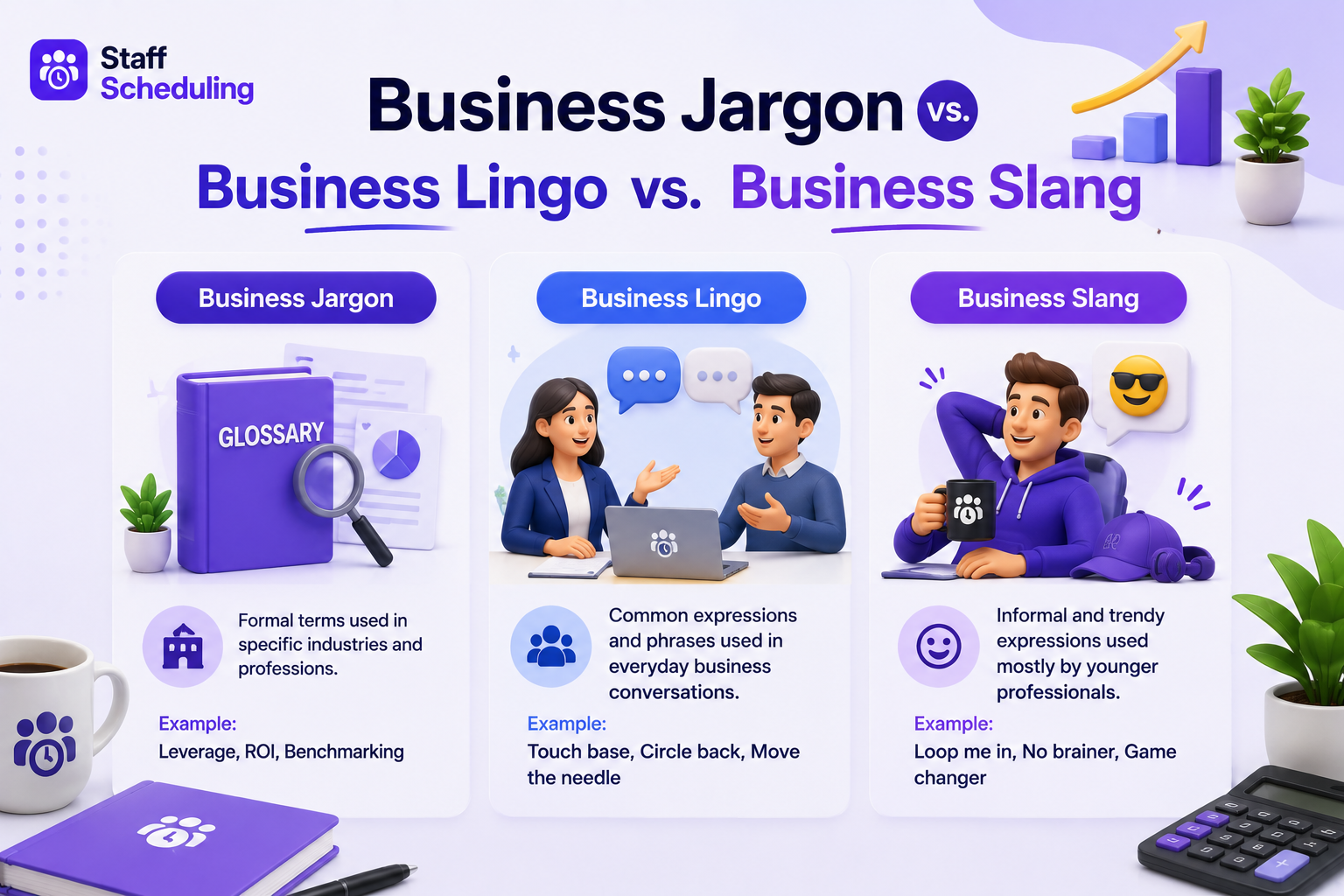
These three terms are often used as if they mean the same thing, but there is a small difference between them. Understanding the difference can help you choose the right words for emails, meetings, and everyday conversations at work.
What Is Business Lingo?
Business lingo is the common language used by people in a particular workplace, company, or industry. It can include both formal terms and casual phrases that employees understand.
For example, a marketing team may regularly talk about “leads,” “conversions,” and “campaigns.” These words are part of their everyday work language.
Business lingo is not always complicated. It simply refers to the words and phrases that are common among a certain group of business professionals.
What Is Business Slang?
Business slang is informal language used in workplace conversations. It is usually more casual than standard business language and may be common among certain teams, industries, or groups of employees.
For example, coworkers might say “a quick win” when talking about an easy task that can produce a fast result. Some workplace slang may also come from everyday speech rather than formal business terms.
Business slang can make conversations feel more relaxed, but it may not be suitable for formal emails, reports, or communication with customers.
How Business Jargon Differs From Lingo and Slang
The easiest way to understand the difference is to look at how each term is used:
| Term | Simple meaning | Example |
| Business jargon | Special terms used for business ideas or work | “ROI” |
| Business lingo | Common language used by a workplace or industry | “Campaign” |
| Business slang | Informal workplace language | “Quick win” |
Business jargon often has a specific meaning within a professional setting. Business lingo is broader and can include the normal language a group uses every day. Business slang is usually more informal.
For example, a sales team may use “conversion” as professional jargon, call their everyday work language sales lingo, and use a casual phrase like “quick win” as workplace slang.
When in doubt, choose clear and simple language. It is especially important when speaking with customers, new employees, or people who may not know the terms your team uses.
When Should You Use Business Jargon?
Business jargon is not always bad. The right term can make a work conversation faster and easier when everyone understands it. The key is to think about who you are speaking to and whether the term actually makes your message clearer.
When Your Audience Understands the Terms
You can use business jargon when the people you are speaking with already know the terms. For example, a marketing team can normally use words like “conversion,” “lead,” or “ROI” because these are common in their work.
There is no need to explain every familiar term when your audience already understands it.
When Jargon Makes Communication Easier
Use jargon when it helps you explain an idea in a simple and quick way. Common business communication words can save time when a team uses them regularly.
For example, saying “Let's circle back tomorrow” is quicker than saying, “Let's discuss this topic again tomorrow.” If everyone understands the phrase, it can make the conversation more efficient.
When Discussing Industry-Specific Topics
Professional terminology can be useful when discussing topics that have specific meanings within an industry. Finance, technology, marketing, healthcare, and law all have terms that professionals use regularly.
For example, a financial team may use “ROI” when discussing the return from an investment. Using the correct term can be clearer than explaining the full meaning every time.
When Speaking With Your Professional Team
Jargon can work well inside a team that shares the same corporate vocabulary. Team members often understand the same terms because they work with the same systems, goals, and processes.
For example, a project team may use words like “deliverable,” “deadline,” and “stakeholder” during meetings. These terms can make discussions shorter when everyone knows what they mean.
Still, it is a good idea to explain unfamiliar terms when a new employee joins the team or when someone from another department is involved.
When Should You Avoid Business Jargon?
Business jargon can be useful in the right situation, but using too much of it can make your message harder to understand. If your audience may not know a term, clear and simple language is usually the better choice.
When Talking to Customers
Avoid complex jargon when speaking with customers. Your customers should not have to understand your company's internal language to understand your product, service, or message.
Use simple business communication words instead. For example, instead of saying, “We will escalate your ticket to the relevant department,” you could say, “We will send your request to the right team.”
Clear language helps customers understand what will happen next.
When Writing for a General Audience
When writing for a large or general audience, avoid terms that only people in a certain industry may understand. This is especially important for websites, blogs, guides, and public announcements.
Even professional words for business can be confusing if they are not familiar to the reader. Choose common words whenever they can explain the idea just as well.
For example, instead of “utilize our platform,” simply say “use our platform.”
When Communicating With International Teams
Jargon can cause problems when people from different countries and language backgrounds work together. A phrase that seems obvious to one person may be confusing to someone else.
Using simple business communication words can reduce misunderstandings. It also makes emails, meetings, and instructions easier for everyone to follow.
For example, “Let's discuss this again tomorrow” is clearer for an international team than “Let's circle back tomorrow.”
When a Simple Word Is Clearer
The best reason to avoid business jargon is simple: if an ordinary word explains the idea better, use it.
For example:
- Use “use” instead of “leverage.”
- Use “help” instead of “facilitate.”
- Use “start” instead of “commence.”
- Use “change” instead of “pivot” when you are simply talking about a change.
Professional communication does not need to sound complicated. If people can understand your message quickly, your choice of words is doing its job.
Business Jargon to Avoid and What to Say Instead
Some business jargon and business buzzwords are so common that people use them without thinking. The problem is that these phrases can sometimes make a simple message sound unclear or overly formal.
You do not need to remove every business term from your vocabulary. Instead, ask yourself whether a simpler word would make your message easier to understand.
| Business Jargon | Simple Alternative |
| Circle back | Talk again |
| Leverage | Use |
| Touch base | Contact |
| Move the needle | Improve results |
| Think outside the box | Find a creative solution |
| Low-hanging fruit | Easy opportunity |
| Synergy | Work together |
| Bandwidth | Time or capacity |
For example, instead of saying, “Let's circle back on this next week,” you can simply say, “Let's talk about this next week.” Both sentences have the same basic meaning, but the second one is easier for almost anyone to understand.
The goal is not to avoid business jargon completely. Use a term when it is useful and your audience understands it. But when a simple word works just as well, choosing the simpler option usually makes your communication clearer.
How to Communicate Clearly Without Jargon
Good workplace communication is not about using the most impressive words. It is about making sure people understand your message quickly. Using simple business communication words can help reduce confusion and make your emails, meetings, and presentations easier to follow.
Use Clear and Simple Words
Choose words that most people understand. You do not need complicated professional words for business to sound confident or professional.
For example, use “use” instead of “utilize” and “help” instead of “facilitate” when the simpler word gives the same meaning.
Choose Specific Words
Strong communication is often more specific. Using strong business words can help people understand exactly what you mean and what action you expect.
Instead of saying, “We need to improve things,” say, “We need to reduce customer waiting time.”
The second sentence gives the reader a clear idea of what needs to change.
Know Your Audience
Think about who will read or hear your message before choosing your words. The business communication words you use with your team may not work well with customers or the general public.
For example, a finance team may understand “ROI” immediately, while a new customer may need the term explained.
Explain Technical Terms
Some professional terminology cannot be avoided because it has a specific meaning. When you need to use such a term, explain it in simple language the first time.
For example, you could write, “ROI, or return on investment, shows how much money a business earns compared with what it spends.”
This lets the reader understand the term without having to search for its meaning.
Avoid Unnecessary Buzzwords
Popular business buzzwords can make writing sound modern, but using too many can weaken your message.
Instead of filling a sentence with phrases like “move the needle,” “think outside the box,” and “leverage our resources,” say exactly what you want to happen.
Clear words are often more useful than trendy ones.
Focus on the Message, Not the Vocabulary
Your main goal is to communicate an idea, not to show how many professional terms you know. Good business communication words should make your message easier to understand.
Before sending an email or giving a presentation, ask yourself: “Could I say this more simply?”
If the answer is yes, choose the simpler version. Clear communication helps people understand your point, take action, and avoid unnecessary confusion.
Conclusion
Business jargon is simply the special language people use in workplaces and different industries. It can make communication faster when everyone understands the terms, especially within the same team or profession.
However, professional communication does not need complicated words to sound professional. When a simple word can explain your idea clearly, it is usually the better choice. Always consider your audience, explain unfamiliar terms, and focus on making your message easy to understand.
Frequently Asked Questions About Business Jargon
Make Workplace Management Simple With Staff Scheduling
Spend less time managing schedules and more time focusing on your team. Staff Scheduling helps you create schedules, manage availability, handle leave requests, and keep your workforce organized in one place.
Start Free Trial